Healthcare Dive, MedTech Dive and BioPharma Dive collaborated on this five-part series examining changes at the HHS one year after sweeping layoffs. The series explores impacts across the department and provides inside looks at the CDRH, CMS, CDC and FDA.
“We’re working like crazy because there’s not enough people and there’s no incentive. I don’t know what’s keeping us going most days, except for each other.” Scroll down ›
“It’s been a rough year. I don’t think I’ve probably emotionally unpacked all of it. And I’m mourning the loss of a job I really loved.”
“Everybody feels deflated. Deflated is a good term to use. It’s like the air was taken out of us.”
“I’ll try to tough it out as long as I can, but I’m kind of reaching my breaking point. And I’m not the only one.”
“I really struggle with how I can work for people that just lack any humanity and morality.”
“I don’t know how much longer I’m going to last. One day at a time.”
These are the words of employees of the Department of Health and Human Services, one year after the Trump administration laid off thousands of its workers — leaving those remaining facing unsustainably heavy workloads, restrictive bureaucratic hurdles and a marked loss of institutional knowledge they say is impacting the HHS’ mission and Americans’ health.
Last spring, the Trump administration kicked off a dramatic restructuring of the massive department, which oversees much of the American healthcare system through agencies like the Centers for Disease Control and Prevention, the Food and Drug Administration and the Centers for Medicare and Medicaid Services — handling public health emergency preparedness, ensuring food, drug and medical device safety, conducting medical research and administering major insurance programs like Medicare and Medicaid.
The reorganization was tied up in lawsuits, but the brunt of the layoffs were eventually carried out. The smoke has settled since on a smaller, unfriendlier and more chaotic workplace, according to HHS employees interviewed by Healthcare Dive, which has led more workers to pursue early retirement or find scarce jobs in the private sector.
“They’ve instilled a fear in staff that has run so deep. And people are fleeing. Every day there’s more people leaving,” an HHS staffer said.
The HHS’ workforce shrunk by more than 15,000 people between the last months of the Biden administration and the fall of 2025, after the layoffs went into effect. Almost 3,000 additional people left the HHS between the fall of 2025 and this January, according to a Healthcare Dive analysis of government personnel data.
All told, the HHS’ workforce has fallen from 92,000 people to just shy of 75,000 over President Donald Trump’s second term, the data shows.
The layoffs and subsequent attrition have winnowed staffing levels to such an extent that sources in divisions particularly affected described feeling like they were working on a skeleton crew. And the work of the HHS is suffering as a result, they said.
“It took them just a few weeks to break things that are going to take decades to fix,” a former worker in the HHS’ Office of the Assistant Secretary who was affected by the layoffs predicted. “I don’t think people realize how detrimental this will end up being.”
Healthcare Dive staff interviewed almost 25 current and former HHS employees for this project, most of whom requested to remain unnamed for fear of retribution from the Trump administration.
Staffers expressed horror at what they described as damage being done to career civil servants and to the integrity of the HHS, including the callousness of the mass firings, the diminished state of HHS agencies and the controversial priorities of Secretary Robert F. Kennedy Jr. that — to them — don’t reflect the HHS’ mission to enhance the health and well-being of all Americans.
“I don’t recognize HHS anymore. I just can’t. Because the political leadership and what they’re doing is so harmful,” one laid-off employee of the Substance Abuse and Mental Health Services Administration said. “If I had the opportunity to go back, I can’t see myself doing it.”
On the inside, the mood is even more bleak, sources say. As HHS agencies are hobbled by firings, resignations and funding cuts, surviving employees say they have had to absorb the work of their fired colleagues, while contending with fewer job flexibilities and protections as the White House moves to exert greater influence over the federal workforce.
“I still feel very proud to be a fed. But I don’t feel like anyone cares about us, really. The administration itself — we are just completely disposable,” a longtime HHS attorney said.
The HHS has lost more than 18,000 employees over Trump's second term
The disarray at the HHS is radiating well beyond the department itself.
States, tribes, hospitals and other groups that rely on the HHS to fund mental health and substance abuse programs, back research and clinical trials, and help monitor public health threats have seen some of that aid canceled or delayed.
Grant cancellations have forced layoffs at state health departments and health nonprofits, weakened public health efforts and affected biomedical research, according to the Partnership for Public Service.
“It’s so harmful not just to us as employees and to the agency, but to the communities that we are meant to serve. To people in this country who rely on these services and programs. It’s a betrayal to them,” the former SAMHSA worker said. “All of that ground that we made — it feels like it’s slipping through our fingers.”
Concerns have also been growing about political influence creeping into HHS’ decision-making — particularly at the FDA and the CDC, which have experienced a revolving door of leadership.
As Kennedy faces criticism over the HHS’ limited response to the U.S. measles outbreak, his efforts to overhaul the childhood immunization schedule and his promotion of theories at odds with overwhelming scientific consensus, longtime experts have been pushed out of the HHS and replaced by individuals more aligned with the secretary’s aims.
It’s so harmful not just to us as employees and to the agency, but to the communities that we are meant to serve. To people in this country who rely on these services and programs. It’s a betrayal to them.

Former employee
Substance Abuse and Mental Health Services Administration
Through a spokesperson, the HHS refuted the key findings of Healthcare Dive’s reporting, and argued that the restructuring and layoffs have created a stronger and more accountable department.
“The premise of this story ignores the fact that the old status quo wasn’t working. HHS needed long-overdue reform of a system that had become bloated, inefficient, and disconnected from the people it’s supposed to serve,” Andrew Nixon, the HHS’ deputy assistant secretary for media relations, said.
“We’ve broken that status quo and are building a more focused, accountable HHS that delivers real results for the American people. The work continues to move forward as we deliver win after win. The idea that HHS is weaker now simply doesn’t match reality,” he added.
Still, Americans’ confidence in public health agencies is plummeting. Trust in the CDC, FDA and National Institutes of Health, the HHS’ medical research arm, hovered around 75% during the Biden administration. But confidence has dropped to just over 60% over Trump’s second term, according to a recent survey from the Annenberg Public Policy Center of the University of Pennsylvania.
Current and former HHS employees say the Trump administration’s dismantling of the HHS won’t just erode trust in the government’s health institutions. It’ll show up in worse health outcomes for the American people, too — whether forcefully and all at once, like through the CDC being less prepared to respond to another pandemic; or stealthily and over the span of years, from the loss of research into treatments for cancer, heart disease, Alzheimer’s and more.
“I think HHS has set the U.S. healthcare system in the last year back 20 or 30 years,” a former CMS employee said.
The restructuring
The HHS’ reduction-in-force, or RIF, came as part of the Trump administration’s sweeping purge of the federal workforce last year. The goal was to trim the fat, administration officials said, eliminating bureaucratic waste and centralizing functions to make federal departments more efficient.
The RIF in practice was much different — more akin to the HHS, led by staffers of the Department of Governmental Efficiency under the purview of billionaire Elon Musk, taking an axe to the department.
Communications, policy, IT and human resources divisions at multiple agencies were gutted or closed, as were offices focused on health equity and minority health. Scientists studying workplace safety, vaccines, HIV and mental health were laid off, as were workers supporting new medicine reviews, tracking diseases, regulating tobacco products, staffing the 988 suicide hotline and overseeing the U.S. opioid response.
Major divisions like the FDA and NIH lost thousands of employees. But the layoffs hit some smaller agencies particularly hard, given they had fewer workers to begin with.
For example, the Agency for Healthcare Research and Quality, which conducts health quality and safety research, and the Administration for Community Living, which supports older adults and people with disabilities, both lost more than 50% of their staff.
The HHS’ main operating divisions shrunk significantly as the Trump administration culled the federal workforce
The rollout of the RIF was disorganized — perhaps illegally so, as staff and programs were cut indiscriminately without any effort to assess the impact, according to sources and legal experts.
“I don’t have a problem with them getting rid of dead wood. But the way things were handled — that’s the worst part. They just came in and burned it down,” an NIH employee said.
The RIF was officially carried out in July, after the Supreme Court allowed the layoffs to proceed over the protests of employees, states and public health groups. But the chaos that defined the RIF has continued over the rest of Trump’s second term, according to sources within the department.
I don’t have a problem with them getting rid of dead wood. But the way things were handled — that’s the worst part. They just came in and burned it down.
Current employee
National Institutes of Health
For one, key elements of Kennedy’s planned restructuring remain in limbo. The secretary aimed to create a new Administration for a Healthy America, to oversee areas like primary care and maternal health that are currently spread out across different agencies. But the AHA has yet to be formed, sources within the HHS say — likely held up by a lack of authorization from Congress, which would need to approve its creation and funding.
Meanwhile, some staff are still working out of the regional offices that the HHS said it would close in the restructuring, though other workers in those offices were fired or directed to report to D.C. headquarters.
“They said the goal was to curb real estate spending in high cost areas. I don’t think they’ve actually done that,” one HHS employee working out of a regional office said.
The HHS also has yet to deal with some top-level government executives who were placed on administrative leave last year, since their seniority made them difficult to fire outright in the RIF. Healthcare Dive spoke with one such official who was placed on leave last April and has received zero communication from the HHS regarding their employment status since.
“I’m getting paid. My full benefits. To sit at home and watch Netflix and go golfing when it’s warm,” they said. “The department is aware of us. They just don’t know what to do.”
The HHS did not respond on the record to questions about the status of AHA, the closure of regional offices or the status of personnel on administrative leave.
The workers
Meanwhile, HHS employees across divisions particularly hard-hit by the layoffs say they’ve been doing the work of two, three or even four people.
“We are just so severely understaffed. Incredibly, severely understaffed,” said one source in the Administration for Children and Families, which administers dozens of social welfare, child support and family assistance programs like HeadStart.
The ACF lost about 500 employees from the RIFs — about one-fourth of its entire staff — which has caused delays in grants processing and has spurred existing staff to cut corners just to get awards out of the door.
The agency got so behind last year that it stopped conducting external reviews meant to ensure the money was going to the most deserving grantees, according to the staffer.
This year “it’s going to be a crunch again. And people are so defeated and burned out and demoralized that I don’t know how we’re going to get our funding out,” they said.
Similarly, a staffer in the CDC’s injury prevention and control center, which works to prevent overdoses, suicides, car crashes, drownings, falls and more, described struggling to keep those programs afloat after the layoffs decimated staffing last year. They said the firings have likely jeopardized the government’s ability to track and prevent unintentional injuries — the leading cause of death for Americans under the age of 45.
“We have individuals doing the work of multiple people for sure, and it’s absolutely not possible to do it at that level,” they said. “We are doing the bare minimum to keep these programs alive.”
Surviving staffers in multiple offices also described having to take on work outside of their area of expertise.
For example, in the Office of the General Counsel — the HHS’ legal team which advises the department on a range of areas including medical record privacy, food safety and civil rights — many attorneys are being saddled with a higher volume of caseloads, including some outside of their legal background, according to an attorney with the OGC. They said they worried that the quality of the work is suffering as a result.
We have individuals doing the work of multiple people for sure, and it’s absolutely not possible to do it at that level. We are doing the bare minimum to keep these programs alive.
Current employee
CDC National Center for Injury Prevention and Control
Some divisions have kept on or hired contractors to help share the load. But that’s not a silver bullet given contractors don’t have the institutional knowledge or decision-making authority of career civil servants, sources say.
For example, the OASH, which oversees the department’s public health offices and programs, fired the brunt of its IT and cybersecurity staff, leaving mostly contractors to manage the office’s systems.
“It’s been a hot mess,” a former employee with knowledge of OASH’s ongoing operations said. “They have a very important mission and if it fails, it fails the Americans it supports.”
The HHS declined to comment on the workload of its employees or concerns that the HHS’ operations may be suffering as a result of overworked staff.
Regarding reports of low morale, “a few anonymous sources do not speak for the entire agency,” Nixon said. “Framing their views as representative of HHS broadly would be inaccurate. We appreciate all employees across HHS and the great work they are doing.”
The roadblocks
Along with feeling overwhelmed by the level of work, HHS employees interviewed by Healthcare Dive are frustrated by what they describe as unclear and shifting directives, restrictions on external communications and new bureaucratic hurdles that make it more difficult for them to do their jobs.
Staff have been forced to scrub agency websites, research and communications of any references to minority health or health equity as part of the Trump administration’s assault on diversity, equity and inclusion. Staff have faced delays in accessing supplies or getting needed travel approved. Public communications are tightly monitored and controlled by the administration.
For example, CDC staff need to get high-level approval of any language they share, even if it’s just notifying local or state health departments about potential disease exposures, according to multiple sources within the agency.
“If they want to meet with us we have to get clearance — and before we can provide any guidance as well. It’s insane,” one public health worker said. “It feels like HHS is setting the CDC up to fail.”
The HHS refuted that the clearance process has slowed down the CDC’s ability to respond to public health threats.
In addition, last year, the Trump administration put a new review process in place, called Presidential Appointee Approver and Departmental Efficiency Review or “PAA-DER,” that requires employees to get approval from a top HHS official for any contracts or requisitions.
PAA-DER is meant to cut down on waste and ensure taxpayer dollars are being spent on the HHS’ priorities, HHS officials say. But the process has added weeks or even months to the time it takes for a contract to be executed, threatening timely funding for social services programs, addiction and mental health services, medical research programs, Indian Health Service hospitals and more, according to employees across multiple agencies.
They are effectively ending our ability to do our jobs through bureaucracy.
Current employee
Administration for Strategic Preparedness and Response
Staffers slammed PAA-DER as “frustrating,” a “time suck” and a “bottleneck” that could hold up a staggering amount of money: Of the HHS’ annual budget of $2.6 trillion this fiscal year, roughly $1 trillion will go out in the form of contracts and other financial assistance across almost 90,000 separate transactions.
“They are effectively ending our ability to do our jobs through bureaucracy,” a contracting specialist with the Administration for Strategic Preparedness and Response claimed.
New limits on remote work instituted last fall, part of the Trump administration’s push for federal workers to show up to the office full-time, also have employees up in arms.
Instead of being approved by a supervisor, requests for remote work now need to be approved by an official at the assistant secretary level. The change has caused significant delays in the processing of requests — and is potentially illegal because agencies have to provide reasonable accommodations to individuals with disabilities, according to a complaint filed by National Treasury Employees Union, which represents HHS workers.
“It’s kind of disgusting how they’re treating not just disabled veterans but people with real true disabilities. People in remission from cancer. People who are wheelchair-bound. At-risk pregnancies,” said one veteran employed by the CDC who said they weren’t provided a reasonable accommodation for their post-traumatic stress disorder.
“They’re hoping that people quit,” they added. “That’s what it feels like.”
The HHS continues to review reasonable accommodation requests and grant telework when appropriate, according to Nixon.
“We are working through those requests as quickly as possible. Assertions that employees are being forced back to the office without accommodations or that the Department is ignoring disability protections are simply false,” he said.
Workers are also upset about the Trump administration’s changes to the employee performance rating system, which is tied to bonuses, time off and other perks.
Normally, employees are scored on a scale from 1, for unsatisfactory, to 5, for outstanding, with no limits on how many employees can receive high scores. But the Trump administration is putting a new scoring system in place that limits how many employees can be rated above average.
The goal is to normalize performance ratings that have been overly generous in the past, officials argue.
HHS employees interviewed by Healthcare Dive view the situation much differently. The new ratings system, which sources say officially goes into place for the next fiscal year but is already being pushed out in certain agencies, is seen as a transparent effort to lower scores that’s disincentivizing employees to go above and beyond for their jobs.
“The expectation going forward is that everyone is going to get a 3. There’s no incentive to go beyond that, other than your own interest in the mission,” one CDC supervisor said.
“If I’m going to be rated a 3 either way, I will give them a 3 level performance,” an employee with the HHS Office of the Chief Information Officer said. “F— ‘em.”
The dismissed
Reactions are split among HHS employees who survived the RIF last year. Some say they’re grateful to have kept their jobs, while others say they’re almost jealous of colleagues cut free from the federal workforce. White House officials who have said they want to put federal workers “in trauma” have largely succeeded in that goal, HHS employees said.
“We’re all just getting by and we all feel like we’re trying to keep our heads above water. But there’s nothing we can do about it right now. Until the next election,” an NIH employee said.
But things have not been rosy for many workers laid off last year. Former HHS employees affected by the RIF — some of whom had been in the federal workforce for decades — said the sudden loss of their jobs was shocking and deeply painful.
“My sense of self, my values, is strongly tied to being a federal servant. I took that seriously across administrations. I don’t know that I anticipated feeling that loss as deeply as I do,” a former ACF employee said.
Some laid-off workers said they developed depression and anxiety after being fired, or experienced an exacerbation of existing health conditions. All described intense levels of stress as they attempted to navigate the loss of their jobs in a challenging market saturated with government employees, with little-to-no support from the HHS, which fired many of the human resources workers who could have helped.
“The overall anxiety was bad. The stress levels were immense,” a former OASH worker said. “I became borderline agoraphobic at a certain point. I didn’t really want to leave the house. Because it just sucked.”
Many laid-off workers have struggled to find new jobs and have gone months without a paycheck. Those who have found full-time work have often had to take a significant pay cut to do so, including former employees of the NIH, CMS, SAMHSA, ACF and OASH interviewed by Healthcare Dive.
After applying to 150 positions over the past year and only getting three interviews, one former HHS worker found a new job about a month ago making $40,000 less. Another fired HHS employee was offered a job only to have it rescinded as a result of the Trump administration’s cuts to public health funding. They recently accepted another offer at a 40% pay cut.
“There are so many people where this just upended their lives so much more than people think. It’s not like they can just walk out and get another job,” one laid-off CMS employee said.
The situation faced by HHS workers laid off last year is in direct opposition to comments from Trump, who has defended the purge of civil servants and said that fired individuals are now making “sometimes twice as much money, three times as much money” in the private sector.
The HHS declined to comment on the experiences of laid-off employees.
There are so many people where this just upended their lives so much more than people think.
Former employee
Centers for Medicare and Medicaid Services
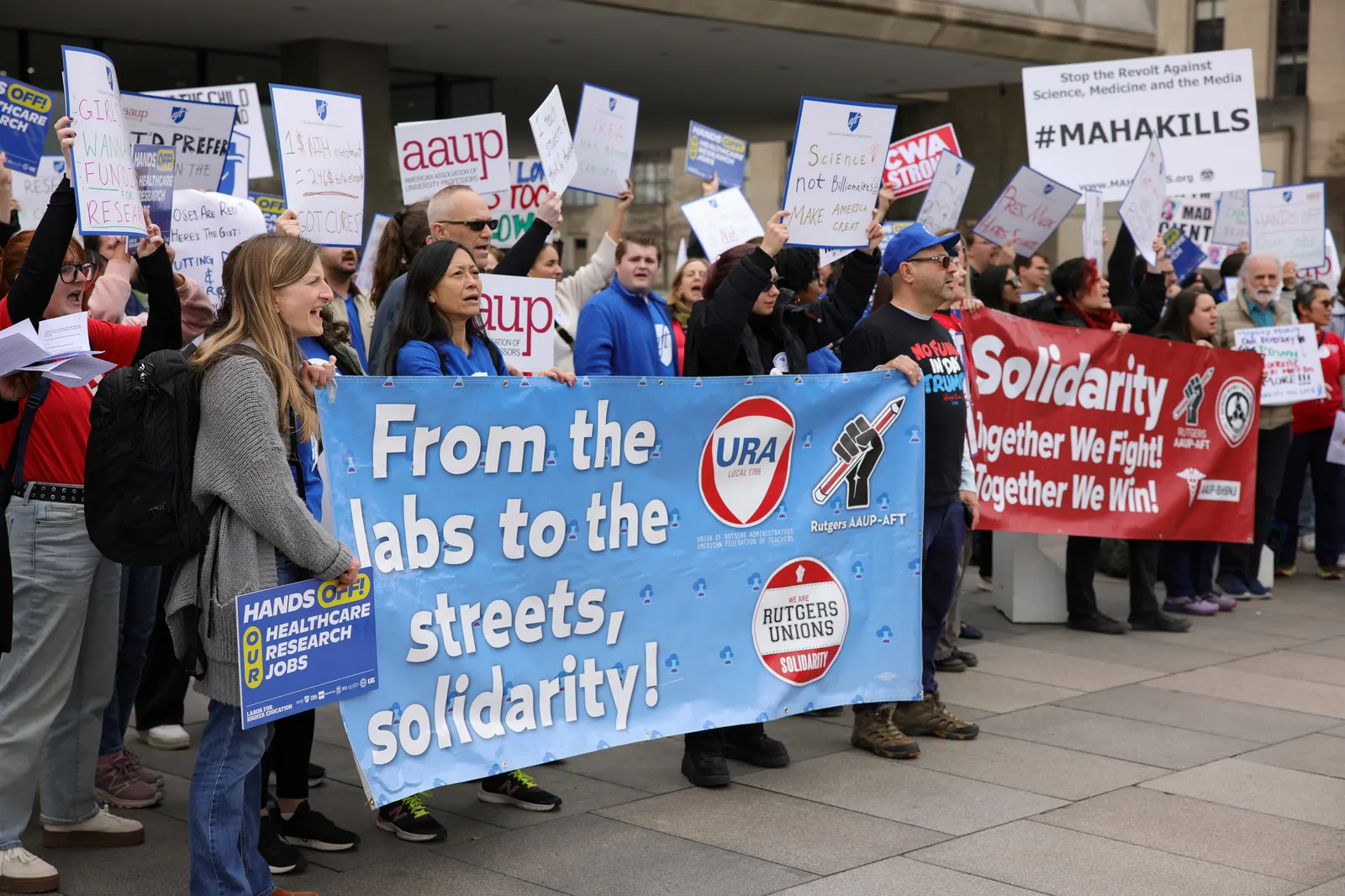
Many employees affected by the RIF have appealed their termination with the Merit Systems Protection Board, a quasi-judicial agency in the executive branch that oversees federal employment issues. The sheer volume of similar appeals led many of the cases to be consolidated, though the process is still in the very early stages, according to a legal update from Fired But Fighting, a coalition of terminated HHS employees, in March.
If the administrative law judges overseeing the MSPB appeals determine the layoffs were illegal — and the government doesn’t appeal their decision — affected employees could get back pay and benefits and even be reinstated in their post.
That’s not to mention potential monetary damages or other relief from a number of lawsuits filed against the Trump administration over its downsizing of the federal workforce, including Jackson v. Kennedy, lodged by HHS staffers with errors in their RIF notices, and New York v. Kennedy, filed by a group of states concerned about cuts to HHS programs.
Still, the cases could take years to work out. And even if offered their jobs back, the majority of RIFed workers that Healthcare Dive spoke to said they wouldn’t come back — at least not under this administration.
“If the pay were right and Trump weren’t in office I’d consider it,” one former CMS employee said. “But it can’t be Trump. It can’t be someone who believes the same things as Trump.”
Others expressed a desire to return one day to help rebuild. They said they pursued careers in civil service because it was an opportunity to do the greatest good at the largest scale — especially at the HHS, given the department’s immense influence over the health and well-being of the American people.
Despite the changes at the HHS, that opportunity remains.
“My hope is that in two years we have a change in administration — not necessarily a change in party, but a change in administration — and that administration realizes that we lost some critical infrastructure and clinical functions and that some sort of restoration or rehiring effort will be needed,” a former ACF worker said. “I would love to be a part of that.”