Dive Brief:
- Two influential House Democrats are accusing a top CMS official of providing inaccurate testimony under oath about the government’s efforts to get in touch with Minnesota before cutting off Medicaid funding to the state.
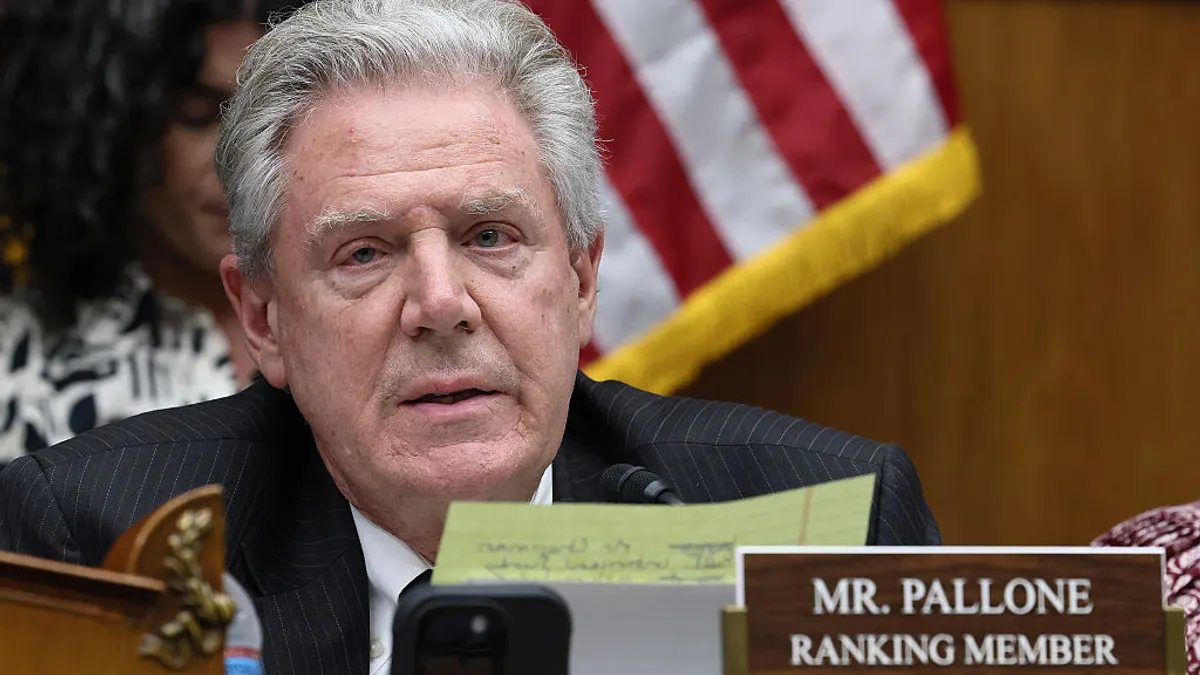
- During a congressional subcommittee hearing on healthcare fraud last week, CMS Chief Operating Officer Kimberly Brandt testified that the CMS was unable to schedule a hearing with Minnesota due to ongoing litigation with the state. But two days after testifying, Brandt requested that the hearing be stayed herself, according to a letter sent to Brandt Tuesday by Rep. Frank Pallone, D-N.J., and Rep. Yvette Clarke, D-N.Y.
- Pallone and Clarke asked Brandt to clarify her statements and to provide documents and communications backing up her position by early April.
Dive Insight:
Brandt testified in front of the Oversight and Investigations Subcommittee on March 17 about CMS’ efforts to combat fraud in federal healthcare programs. During the hearing, she was grilled by Democrats about the Trump administration’s decision to withhold about $250 million in Medicaid funding to Minnesota and its threats to pull back another $2 billion due to concerns about fraud.
The move breaks precedent with how federal regulators normally handle fraud in state Medicaid programs, especially since it appears the CMS didn’t give Minnesota a chance to address the fraud itself before cutting off funding. Democrats, including Minnesota Gov. Tim Walz, have accused the administration of being politically motivated, a charge that Democrat lawmakers questioned Brandt about during the hearing last week.
Brandt, the COO and deputy administrator of the CMS, refuted the accusation. Still, Clarke asked the official to lay out a timeline of events, including why the CMS never met with Minnesota officials to discuss the state’s proposed corrective action plan before cutting off Medicaid funding.
Brandt said that CMS couldn’t schedule a hearing because Minnesota sued the agency in early March.
But that makes no sense, as litigation didn’t begin until March 2 — almost two months after Minnesota requested the hearing, Pallone, the ranking member of the Energy and Commerce Commitee, and Clarke, the ranking member of the Oversight and Investigations Subcommittee, wrote in their letter.
“Despite your answer implying some legal hold on CMS, there was no court order in the litigation that would have prevented a hearing from being scheduled by CMS. And it is unclear who else could or would have ‘stayed’ CMS from scheduling its own administrative hearing, which is entirely within CMS’s own control,” Pallone and Clarke wrote.
The lawmakers said they became more concerned about the accuracy of Brandt’s testimony when — two days after testifying — she wrote to Minnesota requesting that the hearing be stayed.
“There is no clear way that these two contradictory statements by you can be reconciled. And as you provided both the testimony and signed the letter, there can be no excuse of bureaucratic confusion where one official did not know what another official had said or done,” Pallone and Clarke wrote.
The lawmakers gave Brandt until April 7 to revise her testimony or explain how her answers were accurate.
The CMS did not respond to a request for comment by publication.
Combating fraud in government programs has been a pillar of the Trump administration’s health policy agenda, with President Donald Trump announced a “war on fraud” during his State of the Union speech earlier this year, headed by Vice President J.D. Vance.
In February, the CMS announced a new initiative to target fraud in Medicare and Medicaid, called Comprehensive Regulations to Uncover Suspicious Healthcare, or CRUSH. CRUSH started by deferring the $250 million in Medicaid funding from Minnesota to prevent paying out “questionable” claims while regulators investigated the potential fraud.
According to health policy experts, it’s an uncommonly aggressive move. The CMS normally works with states to identify fraud and only halts federal Medicaid payments if that fraud isn’t resolved after investigations that can take years to complete.
The CMS also launched separate Medicaid program integrity inquiries in three other Blue states — California, Maine and New York — sparking concerns the investigations are politically motivated. The Trump administration has denied those allegations, and targeted its first Republican-led state, Florida, in mid-March.